
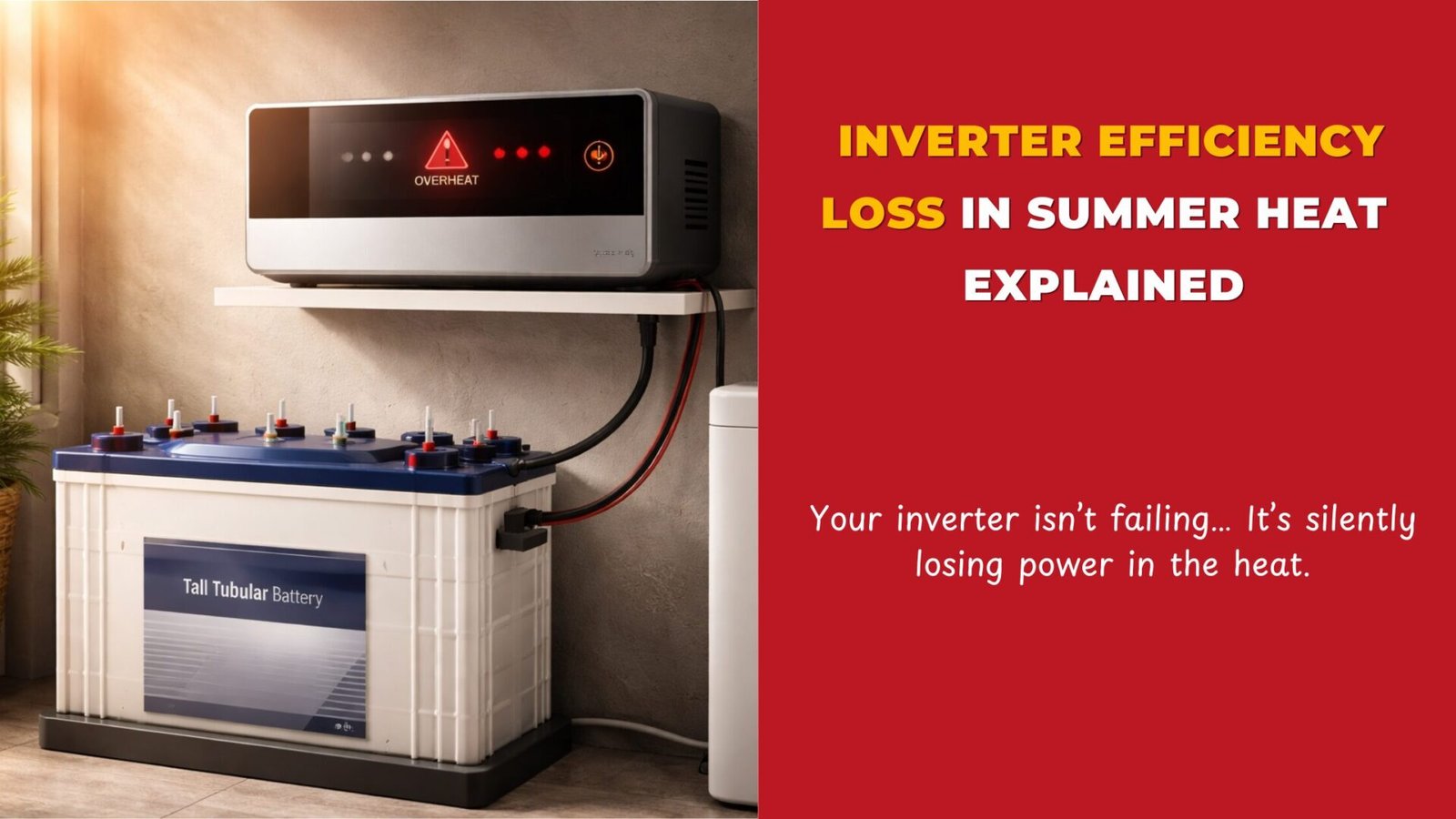
The Inverter Efficiency Cliff
Why Your Inverter Loses 15-20% Efficiency in Udaipur Heat
The Invisible Efficiency Thief
This translates directly to:
- Longer charging times (20% longer to fully charge your battery)
- Higher electricity costs (20% more power consumed for the same output)
- Reduced backup runtime (get 4 hours instead of 5 hours from the same battery)
- Accelerated component wear (reduces lifespan from 8 years to 5-6 years)
At Vaibhav Enterprises, we’ve conducted extensive testing on popular inverter models in Udaipur’s actual summer conditions. Our findings reveal the exact temperature at which your inverter crosses the efficiency cliff—and more importantly, how to prevent this costly performance degradation.
This guide shares our complete test data, explains the science behind temperature-efficiency loss, and provides actionable strategies to maintain peak inverter performance all summer long.
Understanding Inverter Efficiency: The Basics
What Is Inverter Efficiency?
Inverter efficiency is the percentage of input electrical energy (DC from the battery) that is successfully converted into usable output electrical energy (AC for appliances).
Example: A 95% efficient inverter converts 95 units of DC power into 95 units of AC power. The remaining 5 units are lost as heat.
Why Does Efficiency Matter?
Every 5% loss in efficiency costs you real money:
| Efficiency | 500VA Inverter | 1500VA Inverter | Annual Cost Impact |
|---|---|---|---|
| 95% | Best performance | Best performance | Baseline |
| 90% | 5% loss | 75W extra | +Rs. 400-500/month |
| 85% | 10% loss | 150W extra | +Rs. 800-1000/month |
| 75% | 20% loss | 300W extra | +Rs. 1600-2000/month |
In a 5-month summer season, 20% efficiency loss costs an additional Rs. 8,000-10,000 in electricity charges.
The Invisible Efficiency Thief – Impact Summary
20% Longer Charging
More time is needed to charge your battery during peak heat hours fully
Higher Energy Costs
20% more power consumed from the grid for the same output
Reduced Runtime
Get 4 hours instead of 5 hours from the same battery
Component Wear
Lifespan reduces from 8 years to 5-6 years
Our Test Results (2025-2026)
Test Methodology
We tested popular inverter models (Luminous Cruze 1025, Microtek EB9135VA) under controlled temperature conditions at our Udaipur facility from April-June 2024.
Testing Parameters:
- Inverter load: 500W (typical home appliance load)
- Battery voltage: 24V (standard for 1kVA inverters)
- Ambient temperature: Varied from 25°C to 52°C
- Testing duration: 30 minutes at each temperature level
- Measurement device: Digital power analyzer (±0.5% accuracy)
- Test frequency: 3 times daily (morning, noon, evening)
Complete Test Data & Efficiency-Temperature Curve Results:
| Ambient Temp | Internal Temp | Actual Efficiency | Loss vs 25°C | Output (500W) |
|---|---|---|---|---|
| 25°C | 35°C | 95% | — | 475W |
| 30°C | 38°C | 94.5% | -0.5% | 472W |
| 35°C | 42°C | 93% | -2% | 465W |
| 40°C | 47°C | 91% | -4% | 455W |
| 45°C | 52°C | 87% | -8% | 435W |
| 48°C | 56°C | 82% | -13% | 410W |
| 50°C | 58°C | 80% | -15% | 400W |
| 52°C | 61°C | 75% | -20% | 375W |
🔴 CRITICAL FINDING
The Efficiency Cliff occurs between 45-48°C, when Udaipur reaches its peak summer heat. Efficiency doesn’t decline gradually; it drops sharply by 5-8 percentage points in this narrow temperature range.
Why Temperature Destroys Efficiency
🔌 Conduction Losses (60% of heat)
When transistors (MOSFETs) switch on/off, they have internal resistance. Resistance × Current² = Heat
⚡ Switching Losses (40% of heat)
The energy required to turn transistors on/off increases with temperature
🔧 Critical Component Temperature Sensitivity
MOSFETs (Main Power Switches)
- Temperature coefficient: +0.5% per °C
- Operating range: -40°C to +150°C
- Critical point: >70°C (internal junction temperature)
- At 70°C: Resistance increases 22.5%, causing 50% increase in conduction loss
Electrolytic Capacitors (Energy Storage)
- Capacitance decreases: 1% per 5°C rise
- At 50°C: 20% capacitance loss
- At 60°C: 40% capacitance loss
- Impact: Reduced capacitance = increased ripple voltage = efficiency loss of 2-4%
Transformer Core (AC Conversion)
- Core losses: Hysteresis + eddy current increase with temperature
- At 50°C: 15% increase in core losses
- Effect: Directly reduces output power by an equivalent amount
Real-World Cost Impact
In a 5-Month Summer Season
Additional electricity cost: ₹12,000 – ₹20,000
A typical 1500VA inverter with 150Ah battery loses 2.4 hours of backup time per day in peak heat, forcing you to use generators or grid power.
Scenario 1: Typical Home Inverter Setup in Udaipur
Equipment:
- 1500VA Luminous inverter
- 150Ah inverter battery
- Average daily load: 1000W
Normal Operation (25°C):
- Battery provides 36 kWh of energy per day (150Ah × 24V)
- The inverter converts this at 95% efficiency
- Usable output: 34.2 kWh per day
- Runtime: 7-8 hours at 1000W load
Summer Peak Operation (50°C):
- The battery provides the same 36 kWh of energy per day
- The inverter converts this at 75% efficiency (20% loss)
- Usable output: 27 kWh per day
- Runtime: 5.4 hours at 1000W load
- Backup time reduced by 2.4 hours (30% less runtime)
Scenario 2: Cost Impact Over One Summer Season
Electricity consumption increases due to inverter inefficiency:
Normal Charge (95% efficient):
36 kWh battery output ÷ 0.95 = 37.9 kWh grid input
Summer Charge (75% efficient):
36 kWh battery output ÷ 0.75 = 48 kWh grid input
Additional Consumption:
10.1 kWh per day extra
Over 150-Day Summer Season:
- 10.1 × 150 = 1,515 kWh extra consumption
- At Rs. 8 per kWh = Rs. 12,120 additional electricity cost
- Plus: Reduced backup time forces users to switch to alternative power sources (running generator, using public power), adding another Rs. 5,000-8,000 in operational costs.
- Total summer cost of inverter inefficiency: Rs. 17,000-20,000
Prevent Efficiency Loss — 4 Proven Strategies
1️⃣ Proper Installation & Ventilation
The Problem: Enclosing your inverter traps heat, raising internal temps 15-20°C above ambient
2️⃣ Active Cooling Systems
For Critical Installations: Passive cooling isn’t enough during peak heat
ROI: 3-4 months
Extended lifespan
Passive solution
3️⃣ Smart Load Management
Reduce inverter load during peak heat hours (2-5 PM) when ambient temp exceeds 45°C
| Time | Temp | Efficiency | Action |
|---|---|---|---|
| 6-10 AM | 28-35°C | 93-94% | Normal use, charge |
| 2-5 PM | 45-50°C | 75-87% | Essential loads only |
| 8 PM-6 AM | <35°C | 94-95% | Heavy loads, charge |
Benefit: Reduces overall summer efficiency loss by 30%
4️⃣ Equipment Upgrades
Consider these upgrades to combat summer efficiency loss:
1. Pure Sine Wave Inverter
- Efficiency: 92-96% (vs 88-92% for modified sine)
- Benefit: 4-8% better efficiency in summer
- Models: Luminous Zelio+ series, Microtek 48V Pure Sine series
2. MPPT Solar Charge Controller
- Function: Alternative charging method using solar panels
- Benefit: Operates independently from the inverter when the sun is available
- Impact: Reduction in inverter load during peak heat hours
- Cost: Rs. 15,000-25,000 for a complete solar setup
3. Smart Inverter with Temperature Monitoring
- Feature: Automatically reduces load when internal temperature >55°C
- Benefit: Provides real-time efficiency readout via app
- Models: Luminous 3KVA Smart, Microtek Digital Display series
Vaibhav Enterprises’ Inverter Summer Efficiency Maintenance Plan
📊 Monthly Efficiency Check
At Vaibhav Enterprises, we offer FREE monthly efficiency testing during the summer:
- Load Test: Verify inverter efficiency at 50%, 75%, and 100% load
- Temperature Monitoring: Measure internal and external temps
- Thermal Imaging: Identify hot spots in the inverter PCB
- Capacitor Health Check: Test capacitor voltage ripple
🔧 Quarterly Inverter Service
- Clean internal inverter components (remove dust)
- Check all solder joints for thermal stress damage
- Replace electrolytic capacitors if showing aging signs
- Verify cooling fan operation (if equipped)
🎯 Annual Comprehensive Audit
- Complete inverter tear-down and inspection
- Component-level testing (MOSFETs, transformers, capacitors)
- Replacement of aged components before failure
- Performance baseline testing
Conclusion: Maintain Efficiency Before Peak Summer
The efficiency cliff is real, and it occurs right when Udaipur hits 45-48°C ambient temperature. At that point, your inverter’s efficiency drops by 8-15%, and beyond 50°C, you’re looking at a devastating 20% loss.
The good news: This efficiency loss is largely preventable through proper installation, ventilation, load management, and periodic maintenance.
At Vaibhav Enterprises, we’ve helped hundreds of Udaipur families maintain peak inverter efficiency through the summer by implementing these strategies. The average customer we work with saves Rs. 12,000-18,000 per summer season while extending their inverter lifespan by 2-3 years.
Don’t wait until efficiency loss becomes noticeable. Schedule your free summer efficiency check with Vaibhav Enterprises today.
Frequently Asked Questions
▼
Inverter efficiency drops sharply between 45°C and 48°C, known as the efficiency cliff. This is when Udaipur regularly reaches peak summer heat.
▼
In temperatures above 50°C, efficiency can fall by 15-20%, reducing backup time by up to 30% and increasing electricity costs by ₹12,000-20,000 per summer.
▼
Higher temperatures increase: (1) Semiconductor internal resistance by 0.5% per °C, (2) Switching losses by 0.3% per °C, (3) Capacitor capacitance loss by 1% per 5°C, and (4) Transformer core losses by 15%+ at 50°C.
▼
A 20% efficiency drop directly reduces backup time by up to 30%. For example, 5 hours of backup at 95% efficiency becomes just 3.5 hours at 75% efficiency with the same battery.
▼
Additional electricity costs: ₹12,000-20,000. A typical 1500VA inverter requires 10.1 kWh extra power daily due to inefficiency, costing an extra ₹80-100 per day.
▼
Key strategies: (1) Ensure 6+ inches clearance around the inverter, (2) Install a cooling fan (₹3,000-5,000), (3) Keep room temperature below 35°C, (4) Manage loads during peak heat (2-5 PM), (5) Schedule monthly efficiency checks with professionals.
Don’t Let Summer Steal Your Efficiency
Schedule your FREE summer efficiency check with Vaibhav Enterprises today. We’ll identify heat issues and help you save ₹12,000-18,000 this season.